
Post 29: Celebrating Good Friday
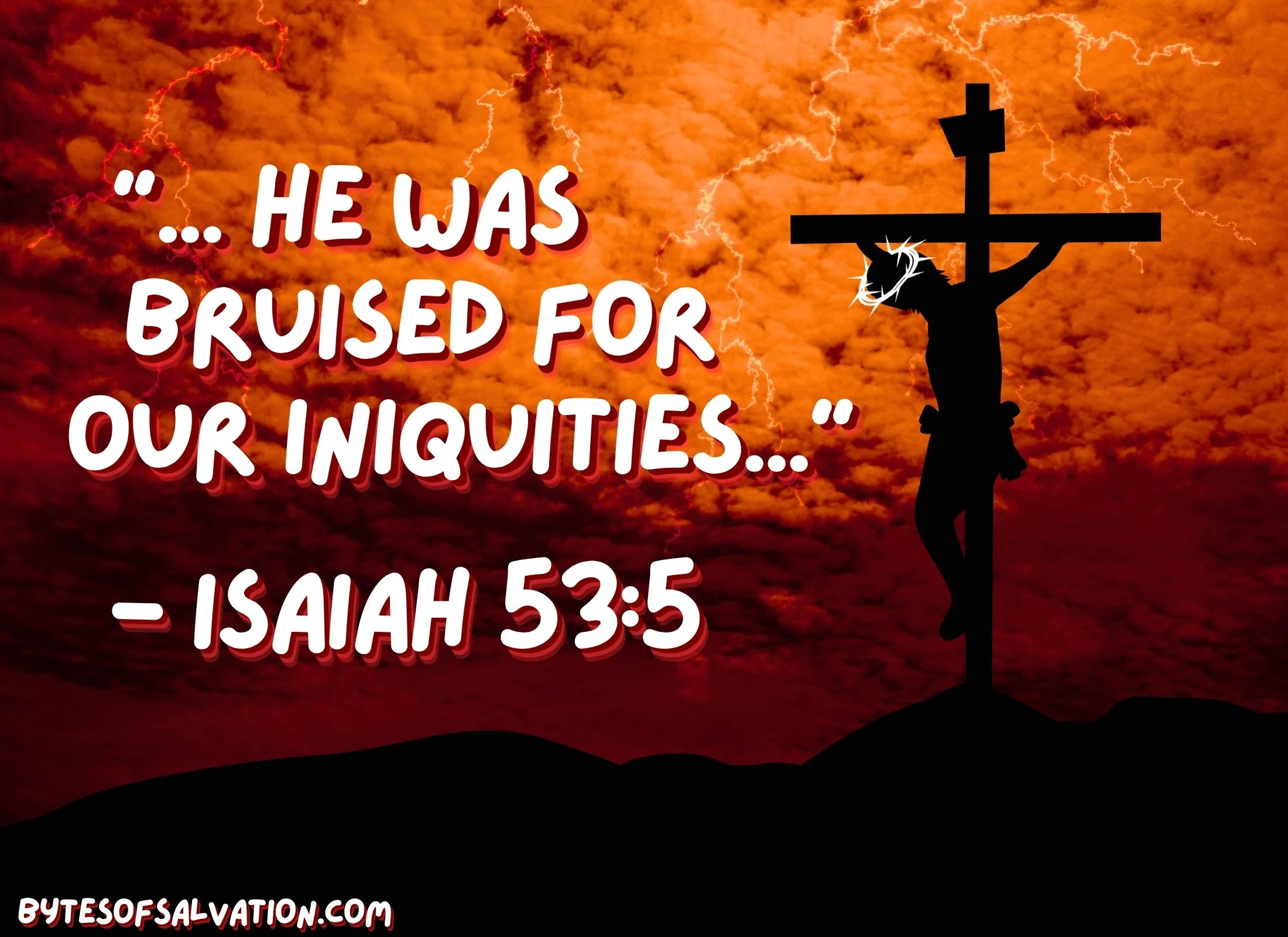
Image: Silhouette image of a man with a crown of thorns on his head, hanging on a cross, which representing Jesus's crucifixion. The sky has dark clouds overhead streaked with lightning. The words "He was bruised for our iniquities", along with the bible reference to Isaiah 53:5, and the website name "bytesofsalvation.com" in the bottom left corner.
Summary: This short post discusses the biblical significance of "Good Friday", offering a summary of events described in the bible, along with differing views on when Jesus was crucified and my own reflections.
Good Friday¹, part of Holy Week, is the holy day set aside by many Christian denominations to honor and reflect on the voluntary crucifixion and death of Jesus Christ, God's one and only son, who died on the cross to save us from our sins.
All four of the gospels provide details of the events surrounding Jesus' betrayal, trials, crucifixion and death (Matthew 26-27, Mark 14-15, Luke 22-23, and John 18-19). In this post, I'll be summarizing the main points relating to Christ's betrayal and crucifixion mainly found in Matthew's Gospel below.
Summary of Jesus Betrayal and Crucifixion
Last Supper & Betrayal: As Jesus is finishing up His teaching on the Final Judgement of mankind (Matthew 25:31-46), the religious leaders and the chief priests plot to arrest and kill Jesus (Matthew 26:3-4). Judas later goes to the chief priests and agrees to betray Jesus for 30 pieces of silver (Matthew 26: 14-16). Jesus shares a final Passover Meal with his disciples, during which He reveals that Judas will betray Him (Matthew 26: 17-25).
During this same meal, Jesus institutes the Lord's Supper, or Communion, with the bread broken represents His body and the wine representing His blood to be shed for the forgiveness of sins (Matthew 26:26-29). While Jesus was later praying in the Garden of Gethsemane, Judas betrays Him with a kiss, and Jesus is arrested (Matthew 26: 36-56).
The Trials: Those who had arrested him brought Him the Chief Priests and the whole council who were seeking false testimony against Him so they could put Him to death, but despite the accusations, Jesus remained silent (Matthew 26:57-63). The High Priest then makes a formal charge of Jesus to confirm whether He is the Son of God, and Jesus does indeed confirm, to which the High Priest acccuses Jesus of blasphemy (Matthew 26:64-65). Jesus is sentenced to die, then spit upon, struck, and mocked (Matthew 26:64-65). Later, Jesus is delivered to the governor Pontius Pilate (Matthew 27:1-2).
Pilate also asks Jesus to confirm whether He was "King of the Jews", which Jesus confirms (Matthew 27:11-12). Pilate continues to question Jesus but He does not answer even one of the charges against him (Matthew 27:13-14). Fulling a custom instituted at the Goveror's Feasts, Pilate releases another prisoner, Barabbas, at the crowds' request, and condemn Jesus to be crucified (Matthew 27:15-26). Then, the soldiers futher mocked Him, smashing the crown of thorns on His head and beating Him, then lead Him away to be crucified (Matthew 27:27-31).
The Crucifixion: Jesus is crucified at Golgotha between two thieves around 9 a.m⁴ (Matthew 27:32-38). Luke's Gospel mentions that one of the criminals crucified with Jesus changes his mind from unbelief to believe that Jesus was telling the truth about who He was, and Jesus saves that thief while dying on the cross (Luke 23:39-43). During the Crucifixion, Jesus cries out, "Eli, Eli, lama sabachthani?" which means "My God, my God, why have you forsaken me?"(Matthew 27:46). This crying out signified the deep anguish Jesus likely felt, thinking He was abandoned by God as He took on the curse of sin on the cross. The suffering of Jesus on this day also fulfilled Isaiah's prophecy regarding the "suffering servant" (Isaiah 53)
Death and Burial: A few hours before Jesus died on the cross, darkness came over the earth (Matthew 27:45). Luke's Gospel also mentions a couple of profound statements Jesus made as He was dying on the cross, including "Father, forgive them; for they know not what they do" (Luke 23:34) and "Father, into thy hands I commit my spirit" (Luke 23:46).The completion of The crucifixion is the fulfillment of biblical prophecy and the completion of Jesus' work to pay for human sin. John's Gospel mentions Jesus' dying declaration "It is Finished", which in the Bible represents the completion of His atoning work (John 19:30).
According to the Gospel Coalition article titled "Good Friday in Real Time", Jesus died on the cross at 3 p.m.⁴ Following His death, there was an earthquake, the tearing of the temple curtain, and dead saints rising from the grave (Matthew 27: 51-54). Jesus is then buried in His tomb, with guards posted to keep watch (Matthew 27: 57-66).
How is Good Friday celebrated/observed?
Good Friday is generally observed on the Friday before Easter, so this year, it falls on April 3, 2026. Many Christian denominations observe Good Friday as a solemn day of mourning, fasting, and reflection around crucifixion and death of Jesus Christ. It is a legal holiday in many places, with some regions restricting public dancing or racing to maintain the solemnity.¹
Churches may have a variety of special or unique services in celebration of Good Friday, incorporating silence, fasting, solemn processions, devotions, and stripping altars of adornments, among other things.¹ For example, one such service often observed by Catholic, Anglican and Lutheran denominations is the Stations of the Cross service, in which 14 stations with images of Jesus's crucifixion and accompanying prayers are arranged in a particular order, and attendees stop at each station to say prayers and offer reflections.¹
The bible does not expressly say that Christians ought to celebrate or observe Good Friday, and a Concordance search showed that the phrase "Good Friday" is not used at all in the bible. God's word does seem to indicate that He gives us the freedom to decide how and when to observe special days like this.² Romans 14:5 says, “One person considers one day more sacred than another; another considers every day alike. Each of them should be fully convinced in their own mind.” I believe this verse does speak to the freedom we have to decide these type of Christian observance days for ourselves.
While I do not believe that the Bible requires Christians to hold any kind of religious observances on specific days, the Bible is clear that Christians ought to regularly observe the rememberance of Christ's sacrifice on the cross. This observance can be through partaking in the Lord's Supper (Matthew 26:26-28, Luke 22:19, 1 Corinthians 11:24-25) as well as setting aside special days, such as "Good Friday", to meditate and reflect on Christ immense suffering on the Cross for the forgiveness of our sins.
A Hot Debate
Prior to writing this post, I did not realize that there were differing viewpoints on the date of Jesus' Crucifixion that suggest He did not actually die on a Friday, but rather on a Wednesday or Thursday. I admit that I had been taught that His crucifixion was on a Friday but some who shared those differing views online did seem to support their view with scripture. GotQuestions.org's Q&A "On what day was Jesus Crucified?" presents each of the 3 differing view points along with additional biblical context and relevant scripture.³
Reflection
As I ponder Jesus' crucifixion during this writing, I am realizing that this day is indeed "good" for a number of reasons. First, God alone is good (Mark 10:18) with Jesus being the Son of God (Matthew 3:17) and the "express image of God"(Hebrews 1:3). Second, God is the giver of all good things (Psalm 16:2, Matthew 7:11, James 1:17). Third, God, in His goodness and grace, gave us the free gift of salvation from sins which came only through the intense suffering of Christ on the cross. This day is indeed "good" because it is a great day for humanity in that the only acceptable payment for the full forgiveness of our sins was made in the death of Jesus Christ (Hebrews 10:1-18), and so is a day worthy of observance.
Conclusion
Regardless of the debating on the day of the week in which Jesus was crucified, it is far more important to believe that He in fact did die for our forgiveness, taking the punishment that we all deserve for our sins. It is also equally important to believe that He did indeed rise again, defeating sin and death, and promises eternal life to those who put their trust in Him alone.
Our salvation is not offered because we can prove that He died on a specific day. It is only through believing that Jesus died for us to reconcile us to God (Romans 5:10, Colossians 1:20-22) and by faith in Christ can we be saved from condemation to eternal life (John 3:16-18). In my humble opinion, debating the specific day of His Crucifixion only serves to be a distraction from focusing on Him and the saving work He did on the cross!
May God bless your "Good Friday"!
References: